
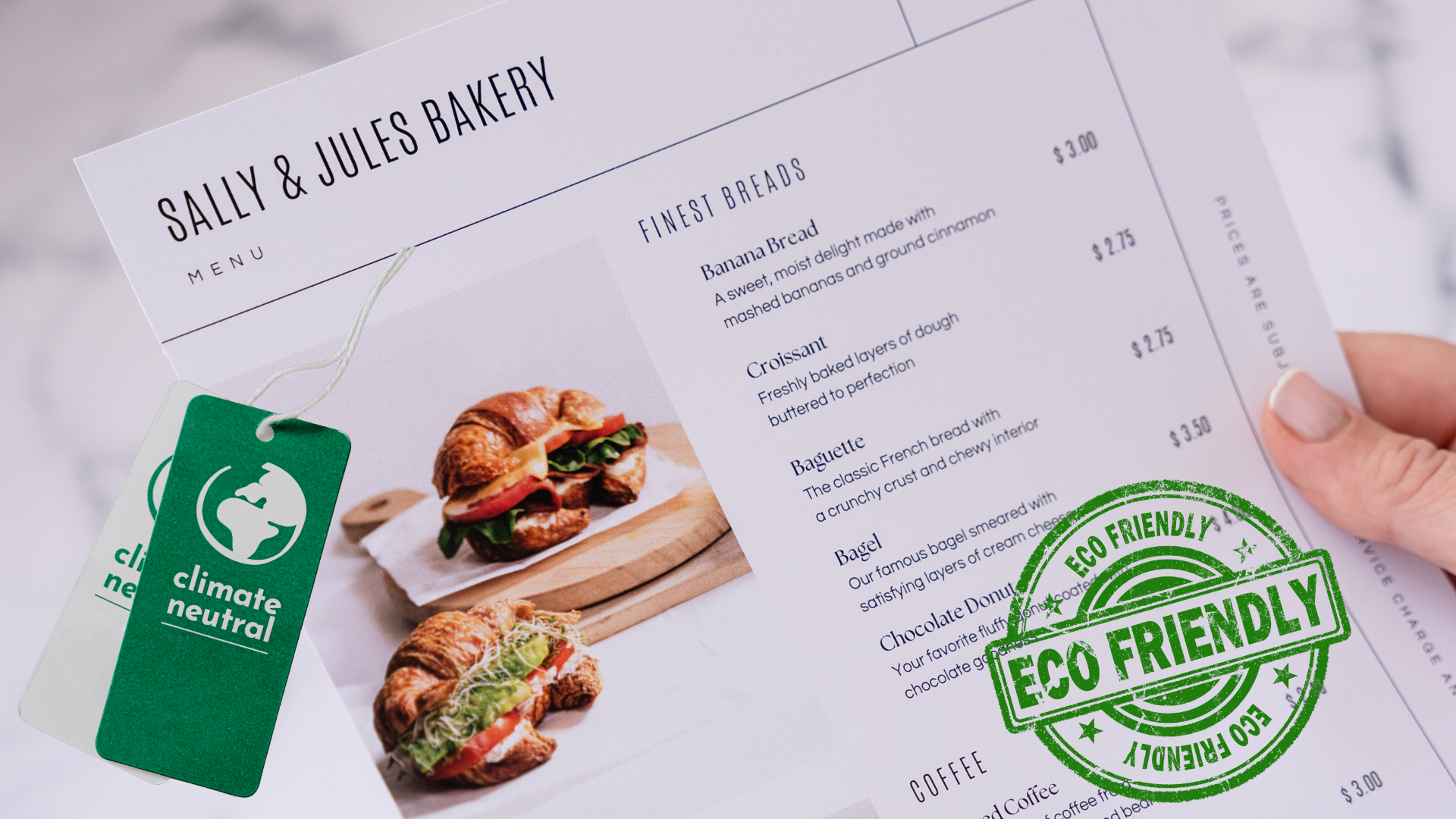
FOOD SERVICE GREEN CLAIMS GUIDE
NAVIGATING THE GREEN CLAIMS CODE AND EMPOWERING CONSUMERS DIRECTIVE (EmpCO)
Environmental claims across food service operations – such as “sustainably farmed”, “eco-friendly packaging”, or “low-carbon dish” – are now subject to strict legal enforcement in the UK and Europe.
Regulators have moved beyond voluntary guidelines to mandatory consumer protection laws with severe financial penalties. Food service businesses operating in the UK must comply with the CMA’s established Green Claims Code, while those distributing across Europe must prepare for the EU Empowering Consumers Directive (EmpCO) deadline of September 2026.
Food service operators must now align packaging, menus, and digital marketing copy with the Competition and Markets Authority (CMA) established Green Claims Code, and the EU’s incoming Empowering Consumers for the Green Transition Directive (EmpCO EU 2024/825).
EXISTING REGULATIONS VS. EMPOWERING CONSUMERS DIRECTIVE (EmpCO): WHAT IS CHANGING?
Environmental marketing in food service is transitioning from voluntary self-regulation to legally binding prohibition backed by direct financial penalties. To safeguard business margins and brand reputation, commercial buyers and operations leads must evaluate how existing rules compare with incoming legislation:
EXISTING LEGISLATION
- 6 Core Principles: Claims must be truthful, unambiguous, account for full lifecycle impact, backed by verified evidence, and offer fair comparisons under the CMA Green Claims Code.
- Broad Operational Scope: Covers all consumer-facing channels including digital menus, takeaway packaging, social media marketing, and delivery aggregator listings.
- Enforcement & Direct Fines: Co-regulated by the UK CMA and the ASA, backed by direct civil penalties of up to 10% of global annual turnover under the Digital Markets, Competition and Consumers Act 2024.
NEW LEGISLATION (September 2026)
- Blacklisting Generic Terms: Total prohibition of generic descriptors like “eco-friendly,” “green,” “bio-based,” or “climate-smart” without verified, recognized environmental excellence.
- Total Carbon Offset Ban: Strict legal ban on claiming menu items or packaging are “carbon neutral,” “net zero,” or “climate-compensated” via external offset purchases under EmpCO Directive (EU 2024/825).
- Verification Mandate: In-house eco-badges or custom environmental logos are not allowed unless backed by official public schemes or accredited third-party certification.
COMMERCIAL & OPERATIONAL IMPACT ON FOOD SERVICE BUYERS
Substantial Financial Risk: Relying on unverified supplier claims or offset credits leaves businesses exposed to severe regulatory fines (up to 10% of turnover under UK DMCC powers) and forced public retractment notices. Food service leads must transition away from manual, paper-based claims tracking toward automated, software-driven Lifecycle Assessments (LCA) at the recipe and ingredient level.
THE THREE PILLARS OF LEGAL GREEN CLAIMS COMPLIANCE IN FOOD SERVICE
Achieving long-term compliance across catering and food service operations relies on three core operational pillars:
 PILLAR 1
AUTOMATED LIFECYCLE SUBSTANTIATION
Under the CMA Green Claims Code, claims must evaluate full product lifecycle impact. Highlighting sustainable agricultural sourcing while ignoring non-recyclable packaging or high-emission processing constitutes unlawful greenwashing.
ELIMINATION OF OFFSET & GENERIC CLAIMS
The EmpCO Directive (EU 2024/825) explicitly bans generic claims like “green” or “eco-friendly.” Crucially, claiming a food dish or meal kit is “carbon neutral” based on tree-planting offset schemes is legally blacklisted.
 PILLAR 3
VERIFIED CERTIFICATIONS & SCIENCE DATA
Environmental claims and eco-scores must be backed by official public schemes or accredited third-party verification. Future carbon reduction claims require transparent, publicly accessible implementation roadmaps verified by external audit data.
ACTION PLAN FOR GREEN CLAIMS CONTROL IN FOOD SERVICE
Commercial buyers and operations directors must embed automated compliance into daily workflows. Follow this 6-step action plan to mitigate risk and streamline environmental marketing across your brand:
1. AUDIT ALL PACKAGING & MENU CLAIMS
Conduct a complete inventory of every environmental claim printed on takeaway containers, hot cup sleeves, napkins, printed menus, digital ordering apps, and marketing channels. Flag all unverified claims for immediate correction.
2. ELIMINATE UNVERIFIED CARBON OFFSET STATEMENTS
Immediately remove claims like “Carbon Neutral Lunch” or “Climate Compensated Meal” that rely on tree-planting or external carbon credits. Under the EmpCO Directive, claims of climate neutrality based on offsetting are banned.
3. IMPLEMENT AUTOMATED RECIPE-LEVEL CARBON ACCOUNTING
Replace manual spreadsheets with automated recipe management software that calculates CO2e per dish directly from supplier ingredient databases. Software-driven LCA calculations provide instant audit trails required by regulators like the CMA.
4. SCRUB GENERIC ‘ECO’ LABELS & UNACCREDITED LOGOS
Replace generic descriptors like “100% Eco-Friendly” or self-designed “Green Choice” leaf badges. All environmental symbols must belong to officially recognized public certification schemes or independent third-party verification standards.
5. ALIGN WITH THIRD-PARTY CERTIFICATIONS & PUBLIC SCHEMES
Ensure packaging claims cite specific, recognized standards (such as FSC, PEFC, or EN 13432 industrial compostability). If advertising corporate carbon targets, publish detailed, externally monitored implementation roadmaps.
6. PUBLISH REAL-TIME DYNAMIC CARBON MENUS
Publishing clear, QR-accessible digital menus integrated with live recipe environmental software allows consumers to view verified dish footprints (A-E carbon ratings or CO2e grams) directly, protecting caterers from misleading marketing liability.
CHECK IF YOUR GREEN CLAIM ALIGNS WITH RECOMMENDED BEST PRACTICE
Select the option that best describes your menu, packaging, or marketing environmental claim to evaluate how well it aligns with established guidelines under the Green Claims Code and incoming EmpCO rules.
EVALUATION RESULT
Result details will appear here.
BEST PRACTICE MANAGEMENT FOR ENVIRONMENTAL MARKETING
To exceed statutory benchmarks and protect your business against enforcement actions, implement these commercial safeguards:
-
INTEGRATED RECIPE-LEVEL LCA SOFTWARE:
Connect central recipe and procurement software directly to peer-reviewed environmental databases to automate dish carbon footprinting and eliminate manual calculation errors. -
CENTRAL COMPLIANCE REGISTER:
Maintain a centralized digital repository of independent lab testing reports, supplier LCA declarations, and environmental certifications for every packaging SKU and menu item. -
EXPLICIT DISPOSAL INSTRUCTIONS:
Avoid vague terms like “biodegradable” or “compostable.” Clearly state disposal requirements (e.g., “Compostable via Industrial Facilities Only – Do Not Home Compost”).
INSPECTION CHECKLIST FOR GREEN CLAIMS: TRADING STANDARDS & CMA
REGULATORY ENFORCEMENT FRAMEWORKS
Under the UK Digital Markets, Competition and Consumers Act 2024, the CMA possesses direct enforcement power to impose substantial financial penalties (up to 10% of global turnover) without court action for deceptive green claims. Concurrently, Local Trading Standards and the ASA monitor misleading advertising across print, packaging, and digital menus.
Consolidate all supplier specification sheets, dish lifecycle assessment data, and certification evidence in a dedicated green claims audit folder for immediate regulator review.
READY FOR THE GREEN CLAIMS COMPLIANCE DEADLINE?
Do not leave menu copy, carbon claims, and food packaging specs to commercial risk. Audit active packaging lines, evaluate automated recipe LCA tools, and clean unverified environmental claims today.