WHEN IS A QUID REQUIRED?
QUID RULES FOR FOOD BUSINESSES
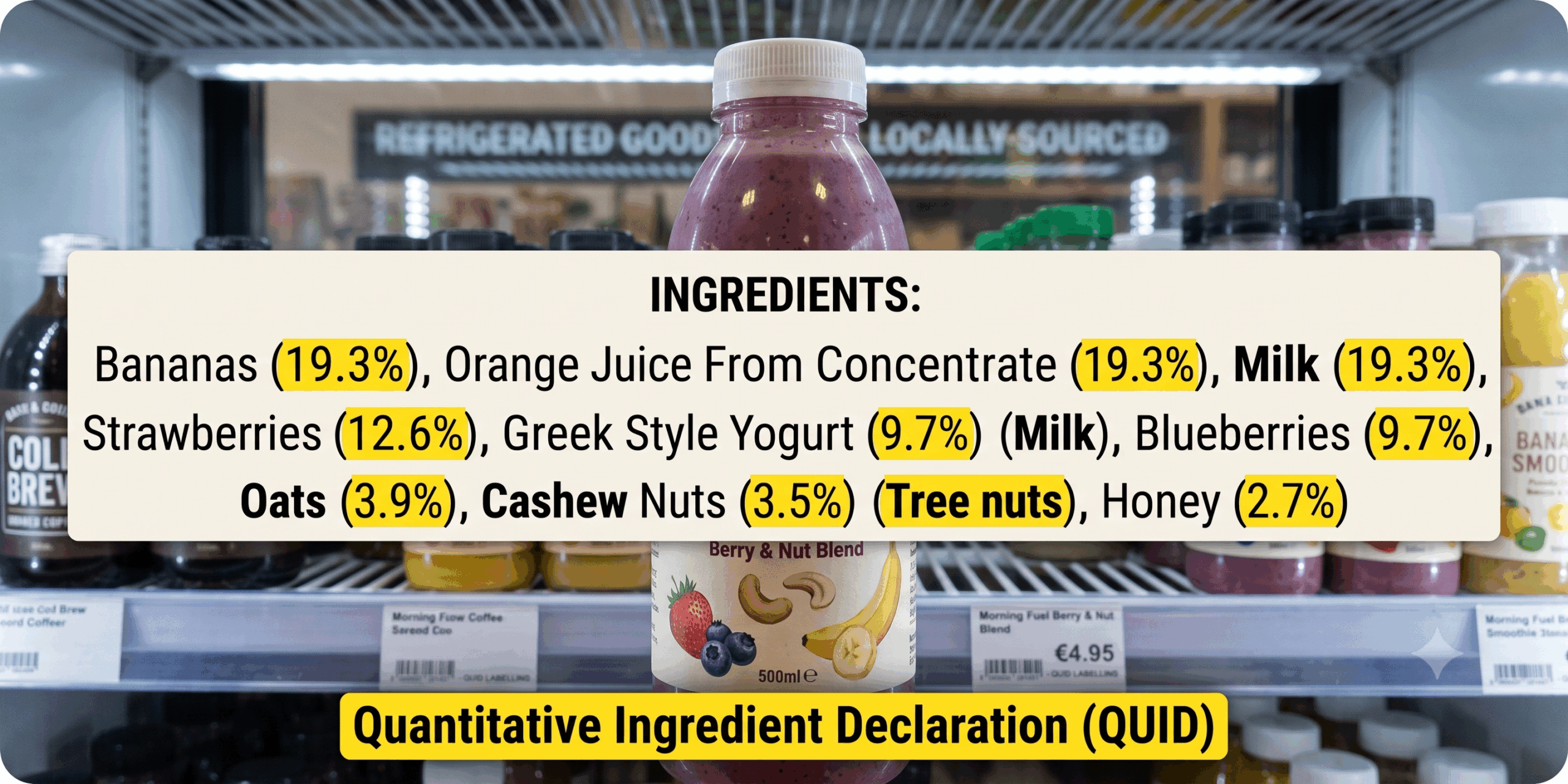
A QUID is the percentage shown next to a key ingredient on a food label, such as “chicken (35%)”. Whether you need one depends on how you sell the food and how you name and present it. This guide explains the rules in plain English for food service and multi-site operators, with real examples and a checker.
QUID IN 30 SECONDS
- Prepacked food needs a QUID when an ingredient is in the name, expected from the name, or highlighted on the pack. This includes food your central kitchen packs and sends to other sites.
- Food served or sold loose, and PPDS food (UK), doesn’t need a QUID, with one exception: some foods containing meat need a meat content declaration. The rule doesn’t cover ready-to-eat meals from restaurants, cafés and canteens, or sandwiches.
- In the EU, QUID only applies to prepacked food under EU law, but individual countries can add rules for loose food.
- The percentage reflects how much of the ingredient goes into the recipe. Our calculation guide shows how to work it out.
KEY TERMS
- QUID
- Quantitative Ingredient Declaration: the percentage shown for a key ingredient, such as “chicken (35%)”.
- Prepacked
- Food put into packaging before it’s offered for sale, so it can’t be changed without opening or altering the pack. Food your central kitchen packs and sends to other sites counts as prepacked.
- Prepacked for direct sale (PPDS) (UK)
- Food packed on the same premises where it’s sold, before a customer orders it, such as sandwiches made and packed in-store each morning.
- Non-prepacked (loose)
- Food sold without packaging, or packed at the customer’s request, such as deli counter food or a meal served at a table.
- Mass caterer
- A business that prepares food ready to eat, such as a restaurant, café, canteen, school, hospital or catering company.
- Mixing bowl stage
- The point at which each ingredient goes into the recipe. QUID uses ingredient weights at this stage.
WHAT IS A QUID?
A QUID shows how much of a key ingredient a food contains, as a percentage. It appears either in or next to the name of the food, such as “Beef lasagne, 22% beef”, or in the ingredients list next to the ingredient, such as “Beef (22%)”. It helps customers see what they’re getting and compare similar products. The rules come from Article 22 and Annex VIII of the Food Information to Consumers Regulation (EU) No 1169/2011, which applies in the EU and Northern Ireland, and as assimilated law in Great Britain.
WHAT TRIGGERS A QUID ON PREPACKED FOOD?
For prepacked food, you need a QUID for an ingredient (or a group of ingredients, such as “vegetables”) if any of these four triggers applies (Article 22):
 TRIGGER 1
IT’S IN THE NAME
For example chicken in a chicken tikka masala, beef in a beef lasagne or strawberries in a strawberry yoghurt. Each named ingredient needs a QUID unless an exemption applies. In a steak and ale pie, the beef needs one; the ale may not, if you only use a small amount for flavour.
 TRIGGER 2
CUSTOMERS EXPECT IT FROM THE NAME
The name doesn’t mention the ingredient, but customers expect it, such as lamb in a shepherd’s pie or beef in a cottage pie.
Photo: freeimages.co.uk
 TRIGGER 3
YOU HIGHLIGHT IT
You draw attention to the ingredient in words, pictures or graphics, such as “made with real butter”, “extra cheese” or a photo of strawberries on the pack. Highlighting it anywhere on the label counts, not just in the name.
 TRIGGER 4
IT DEFINES THE PRODUCT
The ingredient is essential to what the food is, and to telling it apart from similar products that customers could confuse with it because of their name or appearance. In practice, this trigger applies less often than the others.
WHEN YOU DON’T NEED A QUID
Even when a trigger applies, you don’t need a QUID for an ingredient if (Annex VIII, point 1 of Regulation (EU) No 1169/2011):
- it’s only used in a small amount for flavour, such as herbs, spices or a splash of wine;
- it’s named in the food, but the amount doesn’t affect what customers choose, because changing the amount wouldn’t change the character of the food;
- the drained weight is already shown on the label, as with tinned fruit;
- other rules already require the amount to be shown on the label;
- other legislation already fixes exactly how much must be used, without requiring it on the label; or
- it’s part of a mix of fruit, vegetables, mushrooms, herbs or spices where none clearly dominates and the label says the mix is in varying proportions.
Ingredients under 2% are not automatically exempt. The 2% rule only lets you list those ingredients in a different order, after the other ingredients.
HOW YOU SELL THE FOOD CHANGES THE RULES
The triggers above only apply to prepacked food. Food sold loose, served in restaurants or prepacked for direct sale follows different rules, and this is where most food service questions come up.
EXAMPLE: “PORK” IN THE NAME. DO YOU NEED A QUID? (UK)
Having an ingredient in the name only triggers a QUID for prepacked food. For food sold loose or prepacked for direct sale, the name doesn’t matter. Instead, a separate UK rule requires a meat content declaration for foods containing meat, with exceptions for ready-to-eat food from restaurants, cafés and canteens, and for sandwiches.
| Situation | Pork QUID needed? | Why |
|---|---|---|
| Pork sausages packed at your central kitchen and sold at other sites | Yes | Prepacked food with pork in the name |
| Loose, raw pork sausages at a butcher’s counter | Yes | UK meat content rule for non-prepacked food |
| Sausage rolls a supermarket bakery packs for sale in the same store | Yes | UK meat content rule for PPDS food |
| Cooked sausage and mash served in a restaurant | No | Exception for ready-to-eat food from a mass caterer |
| Pork sausage sandwich sold in a café | No | Exception for sandwiches and filled rolls |
Minimum meat content still applies. Even where no QUID is needed, products with a regulated meat name, such as “sausage”, “burger” or “pie”, must meet minimum meat content rules however you sell them.
FORMAT 1PREPACKED FOOD (UK & EU)
PREPACKED FOOD (UK & EU)
You need a QUID whenever a trigger applies and no exemption does.
Examples: lasagne made in your central production unit, packed and sent to sites for grab-and-go; packed sandwiches bought in from a supplier and sold in your cafés.
Multi-site point: if one site packs food that’s sold at another site, it’s prepacked, not PPDS. Full labelling applies, including QUID.
FORMAT 2PREPACKED FOR DIRECT SALE (PPDS)
PREPACKED FOR DIRECT SALE (PPDS)
UK: PPDS food needs the name of the food and a full ingredients list with allergens emphasised. The usual QUID triggers don’t apply. The only QUID requirement is a meat content declaration for foods containing meat, shown on a label on the food or a notice close to it.
The meat rule doesn’t apply to: ready-to-eat food prepared and sold by a mass caterer, such as a restaurant, café or canteen; sandwiches, filled rolls and similar products (but not burgers); pizzas and similar topped products; or raw meat with nothing added other than proteolytic enzymes.
Examples: a supermarket bakery packing its own sausage rolls must show the pork content. A café packing its own sausage rolls doesn’t, because it’s a mass caterer selling ready-to-eat food.
EU: EU law treats PPDS food like non-prepacked food. EU law doesn’t require a QUID, but individual countries can add national rules (Article 44).
FORMAT 3LOOSE FOOD, RESTAURANTS & CATERING
LOOSE FOOD, RESTAURANTS & CATERING
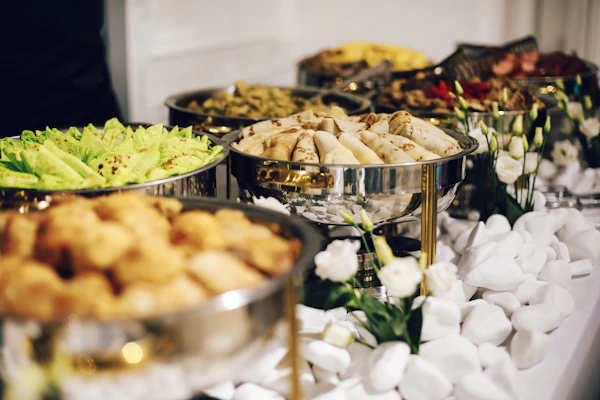
UK: the only QUID requirement for loose food is the same meat content declaration, on a label with the food or a notice close to it, such as a ticket, shelf-edge label or chalkboard. The same exceptions apply, so ready-to-eat meals from restaurants, cafés, canteens and other mass caterers don’t need it.
Examples: a deli counter selling loose, uncooked beef meatballs shows “Beef meatballs, 80% beef” on the shelf-edge label. A restaurant serving cooked meatballs and pasta doesn’t need to declare the beef content.
EU: EU law doesn’t require a QUID for loose food, but individual countries can add national rules (Article 44).
You can choose to show percentages on menus, such as “85% British beef burger”, but they must be accurate.
FORMAT 4ONLINE ORDERING & DELIVERY
ONLINE ORDERING & DELIVERY
For prepacked food sold online or by phone, any required QUID must be available before the customer completes the order, and all mandatory information must be available on delivery (Article 14). For loose food sold this way, you must also make the information required for that food available before the customer completes the order. On delivery apps, make sure the platform shows the same information as your labels.
FORMAT 5SUPPLYING YOUR OWN SITES OR OTHER BUSINESSES
SUPPLYING YOUR OWN SITES OR OTHER BUSINESSES
If you supply food to other sites or businesses, you must pass on the information they need to label it correctly (Article 8). For prepacked food supplied to caterers, some information, including QUID, can go on delivery notes or specification sheets rather than the pack, as long as certain details appear on the outer packaging (Article 8(7)). Make sure every site works from the same, current specification.
FOR MULTI-SITE OPERATORS
Running several sites adds risks that single-site businesses don’t face. Use this checklist to keep QUIDs consistent:
- Classify each product by where it’s packed. The same product can be prepacked at one site and PPDS at another, so the rules can differ.
- Treat central kitchen products as prepacked when they’re sold at other sites, with full labelling including QUID.
- Keep one master recipe per product. Local swaps of ingredients or suppliers can change the QUID, as well as the allergen information.
- Use the same data everywhere. Packs, menus, delivery apps and specification sheets should all show the same figures.
- Review labels when anything changes, including a recipe, a supplier or a cooking method.
A recipe management system can automate QUIDs across all your sites, working out each percentage from your master recipes and updating it when recipes or supplier specifications change. Choose one that follows recognised recipe calculation methods, such as the EuroFIR recipe calculation procedure and FAO/INFOODS guidance.
OUTSIDE THE UK AND EU
Other countries have their own rules. These summaries are a starting point only, so check national law before labelling for any market.
INTERNATIONAL BASELINE: CODEX ALIMENTARIUS
The Codex General Standard for the Labelling of Prepackaged Foods (CXS 1-1985) requires businesses to declare the percentage of an ingredient where the labelling places special emphasis on it. Many countries base their rules on Codex, including the ASEAN General Standard for the Labelling of Prepackaged Food and Gulf Standard GSO 9, but national rules vary.
AUSTRALIA & NEW ZEALAND
Standard 1.2.10 of the Australia New Zealand Food Standards Code requires percentage labelling of characterising ingredients and components. Check the Code for which foods it applies to and the exemptions, including for food that doesn’t need a label.
UNITED STATES
The US has no general QUID requirement, and the ingredients list runs in descending order by weight. However, specific rules require percentages in some cases, such as the juice content of drinks that claim to contain juice (21 CFR 101.30). Any percentage you choose to show must be accurate.
CANADA
Similarly, Canada has no general QUID requirement, and the ingredients list runs in descending order of proportion. Check CFIA labelling requirements for rules on specific products and any percentage claims you make.
DOES MY FOOD NEED A QUID?
Covers UK and EU rules. Answer for one product at a time.
1. WHERE IS THE FOOD SOLD?
2. HOW IS IT SOLD?
3. ABOUT THE FOOD
SEE YOUR RESULT
Enter your details to see your QUID result for this product.
RESULT
Guidance only, not legal advice. Exemptions and national rules can change the answer, so check with your enforcement authority or Primary Authority if you’re unsure.
READY TO CALCULATE YOUR QUID?
Our calculation guide walks through the maths step by step, with food service examples and a calculator.
QUESTIONS ABOUT QUID?
We can answer questions on QUID and labelling, and help with recipe and labelling systems.
OFFICIAL SOURCES
- Regulation (EU) No 1169/2011 (EUR-Lex)
- Annex VIII as it applies in Great Britain
- Commission Notice on the application of the QUID principle (2017/C 393/05)
- Food Information Regulations 2014 (England). Wales, Scotland and Northern Ireland have equivalent regulations.
- Business Companion (Trading Standards): Labelling of prepacked foods: QUID
This page is for general information only and is not legal advice.