Did you know? Codex Alimentarius released new guidance on when to use Precautionary Allergen Labelling (PAL). Begin Free PAL Assessment →

Category: EU

  • When Is a QUID Required? QUID Rules for Food Businesses

    When Is a QUID Required? QUID Rules for Food Businesses

    FOOD LABELLING & COMPLIANCE

    WHEN IS A QUID REQUIRED? QUID RULES FOR FOOD BUSINESSES

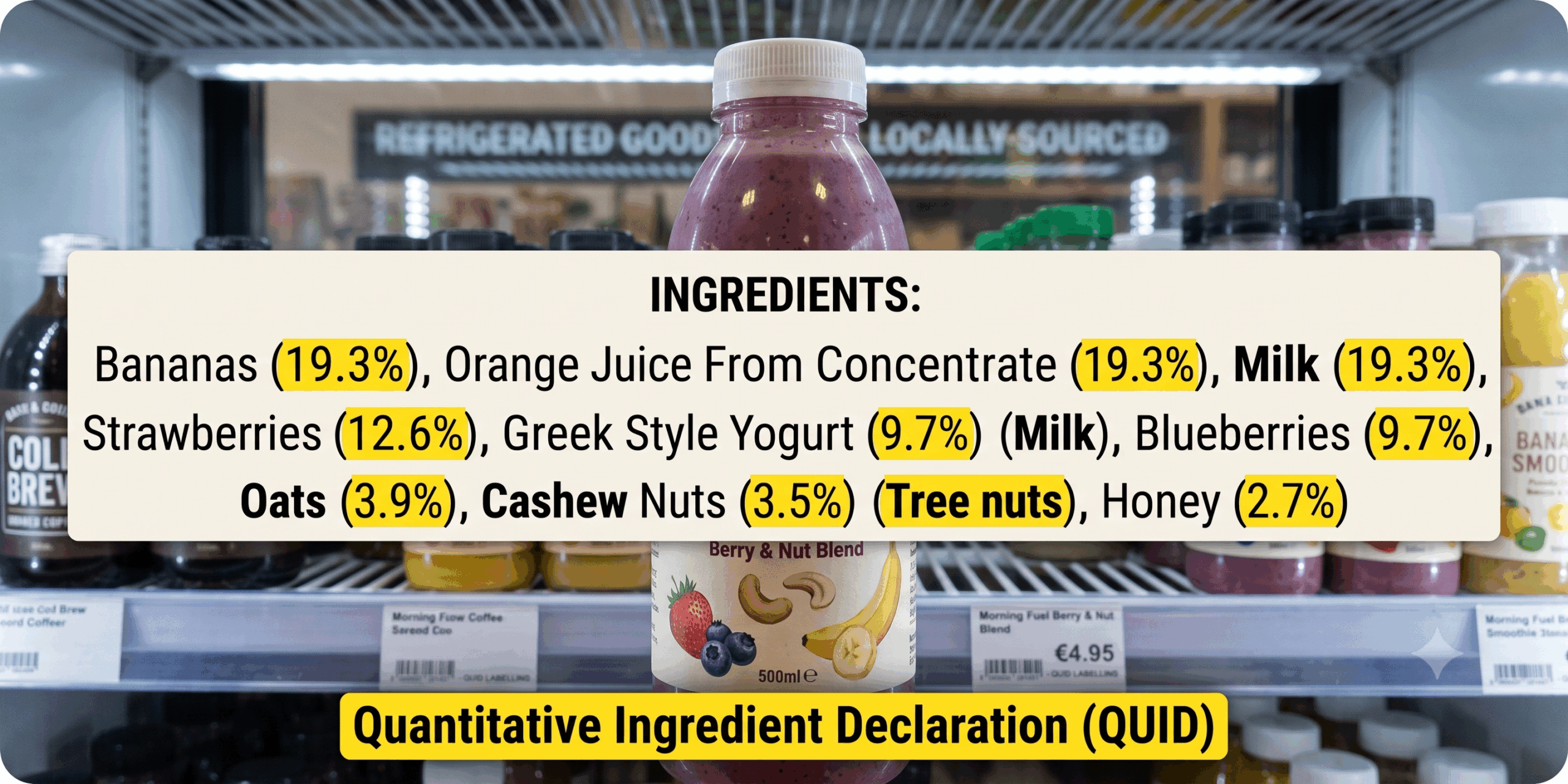
    A QUID is the percentage shown next to a key ingredient on a food label, such as “chicken (35%)”. Whether you need one depends on how you sell the food and how you name and present it. This guide explains the rules in plain English for food service and multi-site operators, with real examples and a checker.

    QUID IN 30 SECONDS

    • Prepacked food needs a QUID when an ingredient is in the name, expected from the name, or highlighted on the pack. This includes food your central kitchen packs and sends to other sites.
    • Food served or sold loose, and PPDS food (UK), doesn’t need a QUID, with one exception: some foods containing meat need a meat content declaration. The rule doesn’t cover ready-to-eat meals from restaurants, cafés and canteens, or sandwiches.
    • In the EU, QUID only applies to prepacked food under EU law, but individual countries can add rules for loose food.
    • The percentage reflects how much of the ingredient goes into the recipe. Our calculation guide shows how to work it out.

    KEY TERMS

    QUID
    Quantitative Ingredient Declaration: the percentage shown for a key ingredient, such as “chicken (35%)”.
    Prepacked
    Food put into packaging before it’s offered for sale, so it can’t be changed without opening or altering the pack. Food your central kitchen packs and sends to other sites counts as prepacked.
    Prepacked for direct sale (PPDS) (UK)
    Food packed on the same premises where it’s sold, before a customer orders it, such as sandwiches made and packed in-store each morning.
    Non-prepacked (loose)
    Food sold without packaging, or packed at the customer’s request, such as deli counter food or a meal served at a table.
    Mass caterer
    A business that prepares food ready to eat, such as a restaurant, café, canteen, school, hospital or catering company.
    Mixing bowl stage
    The point at which each ingredient goes into the recipe. QUID uses ingredient weights at this stage.

    WHAT IS A QUID?

    A QUID shows how much of a key ingredient a food contains, as a percentage. It appears either in or next to the name of the food, such as “Beef lasagne, 22% beef”, or in the ingredients list next to the ingredient, such as “Beef (22%)”. It helps customers see what they’re getting and compare similar products. The rules come from Article 22 and Annex VIII of the Food Information to Consumers Regulation (EU) No 1169/2011, which applies in the EU and Northern Ireland, and as assimilated law in Great Britain.

    WHAT TRIGGERS A QUID ON PREPACKED FOOD?

    For prepacked food, you need a QUID for an ingredient (or a group of ingredients, such as “vegetables”) if any of these four triggers applies (Article 22):

    A meat pie served on a plateTRIGGER 1

    IT’S IN THE NAME

    For example chicken in a chicken tikka masala, beef in a beef lasagne or strawberries in a strawberry yoghurt. Each named ingredient needs a QUID unless an exemption applies. In a steak and ale pie, the beef needs one; the ale may not, if you only use a small amount for flavour.

    Shepherd's pie being prepared with a mashed potato toppingTRIGGER 2

    CUSTOMERS EXPECT IT FROM THE NAME

    The name doesn’t mention the ingredient, but customers expect it, such as lamb in a shepherd’s pie or beef in a cottage pie.

    Photo: freeimages.co.uk

    Blocks of butterTRIGGER 3

    YOU HIGHLIGHT IT

    You draw attention to the ingredient in words, pictures or graphics, such as “made with real butter”, “extra cheese” or a photo of strawberries on the pack. Highlighting it anywhere on the label counts, not just in the name.

    Rows of similar yoghurts in a supermarket chillerTRIGGER 4

    IT DEFINES THE PRODUCT

    The ingredient is essential to what the food is, and to telling it apart from similar products that customers could confuse with it because of their name or appearance. In practice, this trigger applies less often than the others.

    WHEN YOU DON’T NEED A QUID

    Even when a trigger applies, you don’t need a QUID for an ingredient if (Annex VIII, point 1 of Regulation (EU) No 1169/2011):

    • it’s only used in a small amount for flavour, such as herbs, spices or a splash of wine;
    • it’s named in the food, but the amount doesn’t affect what customers choose, because changing the amount wouldn’t change the character of the food;
    • the drained weight is already shown on the label, as with tinned fruit;
    • other rules already require the amount to be shown on the label;
    • other legislation already fixes exactly how much must be used, without requiring it on the label; or
    • it’s part of a mix of fruit, vegetables, mushrooms, herbs or spices where none clearly dominates and the label says the mix is in varying proportions.

    Ingredients under 2% are not automatically exempt. The 2% rule only lets you list those ingredients in a different order, after the other ingredients.

    HOW YOU SELL THE FOOD CHANGES THE RULES

    The triggers above only apply to prepacked food. Food sold loose, served in restaurants or prepacked for direct sale follows different rules, and this is where most food service questions come up.

    EXAMPLE: “PORK” IN THE NAME. DO YOU NEED A QUID? (UK)

    Having an ingredient in the name only triggers a QUID for prepacked food. For food sold loose or prepacked for direct sale, the name doesn’t matter. Instead, a separate UK rule requires a meat content declaration for foods containing meat, with exceptions for ready-to-eat food from restaurants, cafés and canteens, and for sandwiches.

    SituationPork QUID needed?Why
    Pork sausages packed at your central kitchen and sold at other sitesYesPrepacked food with pork in the name
    Loose, raw pork sausages at a butcher’s counterYesUK meat content rule for non-prepacked food
    Sausage rolls a supermarket bakery packs for sale in the same storeYesUK meat content rule for PPDS food
    Cooked sausage and mash served in a restaurantNoException for ready-to-eat food from a mass caterer
    Pork sausage sandwich sold in a caféNoException for sandwiches and filled rolls

    Minimum meat content still applies. Even where no QUID is needed, products with a regulated meat name, such as “sausage”, “burger” or “pie”, must meet minimum meat content rules however you sell them.

    FORMAT 1

    PREPACKED FOOD (UK & EU)

    You need a QUID whenever a trigger applies and no exemption does.

    Examples: lasagne made in your central production unit, packed and sent to sites for grab-and-go; packed sandwiches bought in from a supplier and sold in your cafés.

    Multi-site point: if one site packs food that’s sold at another site, it’s prepacked, not PPDS. Full labelling applies, including QUID.

    FORMAT 2

    PREPACKED FOR DIRECT SALE (PPDS)

    UK: PPDS food needs the name of the food and a full ingredients list with allergens emphasised. The usual QUID triggers don’t apply. The only QUID requirement is a meat content declaration for foods containing meat, shown on a label on the food or a notice close to it.

    The meat rule doesn’t apply to: ready-to-eat food prepared and sold by a mass caterer, such as a restaurant, café or canteen; sandwiches, filled rolls and similar products (but not burgers); pizzas and similar topped products; or raw meat with nothing added other than proteolytic enzymes.

    Examples: a supermarket bakery packing its own sausage rolls must show the pork content. A café packing its own sausage rolls doesn’t, because it’s a mass caterer selling ready-to-eat food.

    EU: EU law treats PPDS food like non-prepacked food. EU law doesn’t require a QUID, but individual countries can add national rules (Article 44).

    FORMAT 3

    LOOSE FOOD, RESTAURANTS & CATERING

    UK: the only QUID requirement for loose food is the same meat content declaration, on a label with the food or a notice close to it, such as a ticket, shelf-edge label or chalkboard. The same exceptions apply, so ready-to-eat meals from restaurants, cafés, canteens and other mass caterers don’t need it.

    Examples: a deli counter selling loose, uncooked beef meatballs shows “Beef meatballs, 80% beef” on the shelf-edge label. A restaurant serving cooked meatballs and pasta doesn’t need to declare the beef content.

    EU: EU law doesn’t require a QUID for loose food, but individual countries can add national rules (Article 44).

    You can choose to show percentages on menus, such as “85% British beef burger”, but they must be accurate.

    FORMAT 4

    ONLINE ORDERING & DELIVERY

    For prepacked food sold online or by phone, any required QUID must be available before the customer completes the order, and all mandatory information must be available on delivery (Article 14). For loose food sold this way, you must also make the information required for that food available before the customer completes the order. On delivery apps, make sure the platform shows the same information as your labels.

    FORMAT 5

    SUPPLYING YOUR OWN SITES OR OTHER BUSINESSES

    If you supply food to other sites or businesses, you must pass on the information they need to label it correctly (Article 8). For prepacked food supplied to caterers, some information, including QUID, can go on delivery notes or specification sheets rather than the pack, as long as certain details appear on the outer packaging (Article 8(7)). Make sure every site works from the same, current specification.

    FOR MULTI-SITE OPERATORS

    Running several sites adds risks that single-site businesses don’t face. Use this checklist to keep QUIDs consistent:

    • Classify each product by where it’s packed. The same product can be prepacked at one site and PPDS at another, so the rules can differ.
    • Treat central kitchen products as prepacked when they’re sold at other sites, with full labelling including QUID.
    • Keep one master recipe per product. Local swaps of ingredients or suppliers can change the QUID, as well as the allergen information.
    • Use the same data everywhere. Packs, menus, delivery apps and specification sheets should all show the same figures.
    • Review labels when anything changes, including a recipe, a supplier or a cooking method.

    A recipe management system can automate QUIDs across all your sites, working out each percentage from your master recipes and updating it when recipes or supplier specifications change. Choose one that follows recognised recipe calculation methods, such as the EuroFIR recipe calculation procedure and FAO/INFOODS guidance.

    OUTSIDE THE UK AND EU

    Other countries have their own rules. These summaries are a starting point only, so check national law before labelling for any market.

    INTERNATIONAL BASELINE: CODEX ALIMENTARIUS

    The Codex General Standard for the Labelling of Prepackaged Foods (CXS 1-1985) requires businesses to declare the percentage of an ingredient where the labelling places special emphasis on it. Many countries base their rules on Codex, including the ASEAN General Standard for the Labelling of Prepackaged Food and Gulf Standard GSO 9, but national rules vary.

    AUSTRALIA & NEW ZEALAND

    Standard 1.2.10 of the Australia New Zealand Food Standards Code requires percentage labelling of characterising ingredients and components. Check the Code for which foods it applies to and the exemptions, including for food that doesn’t need a label.

    UNITED STATES

    The US has no general QUID requirement, and the ingredients list runs in descending order by weight. However, specific rules require percentages in some cases, such as the juice content of drinks that claim to contain juice (21 CFR 101.30). Any percentage you choose to show must be accurate.

    CANADA

    Similarly, Canada has no general QUID requirement, and the ingredients list runs in descending order of proportion. Check CFIA labelling requirements for rules on specific products and any percentage claims you make.

    INTERACTIVE TOOL

    DOES MY FOOD NEED A QUID?

    Covers UK and EU rules. Answer for one product at a time.

    1. WHERE IS THE FOOD SOLD?

    2. HOW IS IT SOLD?

    3. ABOUT THE FOOD


    SEE YOUR RESULT

    Enter your details to see your QUID result for this product.

    Name

    READY TO CALCULATE YOUR QUID?

    Our calculation guide walks through the maths step by step, with food service examples and a calculator.

    HOW TO CALCULATE QUID →

    QUESTIONS ABOUT QUID?

    We can answer questions on QUID and labelling, and help with recipe and labelling systems.

  • Food service green claims guide: Navigating the Green Claims Code and Empowering Consumers Directive (EmpCO)

    Food service green claims guide: Navigating the Green Claims Code and Empowering Consumers Directive (EmpCO)

    FOOD SERVICE REGULATORY COMPLIANCE

    FOOD SERVICE GREEN CLAIMS GUIDE
    THE UK GREEN CLAIMS CODE AND THE EU EMPOWERING CONSUMERS DIRECTIVE (EMPCO)

    Environmental claims in food service, such as “sustainably farmed”, “eco-friendly packaging” or “low-carbon dish”, are regulated by consumer protection law in both the UK and the EU.

    In the UK, misleading green claims have long been unlawful. Since 6 April 2025, the Competition and Markets Authority (CMA) can enforce the law directly and fine businesses without going to court. In the EU, the Empowering Consumers Directive (EmpCo) has applied since 27 September 2026, adding specific bans on certain environmental claims and labels.

    Food service operators need to check that claims on packaging, menus, delivery listings and marketing meet UK consumer law, as explained in the CMA’s Green Claims Code, and, where they make claims to consumers in the EU, the Empowering Consumers for the Green Transition Directive (EU) 2024/825 as implemented in national law.

    UK VS EU GREEN CLAIMS RULES: WHAT APPLIES WHERE

    The UK and EU share the same starting point: environmental claims must not mislead consumers. However, the EU now goes further, with specific practices banned outright. Which rules apply depends on where your customers are.

    UK: CONSUMER LAW, CMA GREEN CLAIMS CODE & ASA

    UK RULES

    • The law: Misleading commercial practices are unlawful under the unfair commercial practices provisions of the Digital Markets, Competition and Consumers Act 2024, which replaced the Consumer Protection from Unfair Trading Regulations 2008 from 6 April 2025.
    • The guidance: The Green Claims Code (2021) explains how that law applies through six principles. Claims must be truthful and accurate; clear and unambiguous; must not omit or hide important relevant information; must make fair and meaningful comparisons; must consider the full life cycle of the product or service; and must be substantiated.
    • Enforcement: The CMA can impose fines of up to £300,000 or 10% of global turnover, whichever is higher, without going to court. Trading Standards also enforce consumer law. The ASA rules on advertising and can have ads withdrawn, but it cannot fine; it can refer cases to other regulators.
    • Supplier claims: CMA supply chain guidance (January 2026) makes clear that businesses are responsible for claims they repeat or pass on, including claims received from suppliers.
    • No banned word list: UK law has no outright list of banned green terms. Each claim is judged on whether it misleads consumers.
    EU: EMPCO DIRECTIVE (EU) 2024/825

    EU RULES (APPLY FROM 27 SEPTEMBER 2026)

    • Scope: Applies to business-to-consumer claims made to consumers in EU member states, through each country’s national law. Not every member state transposed the Directive on time, so check the national rules where you trade.
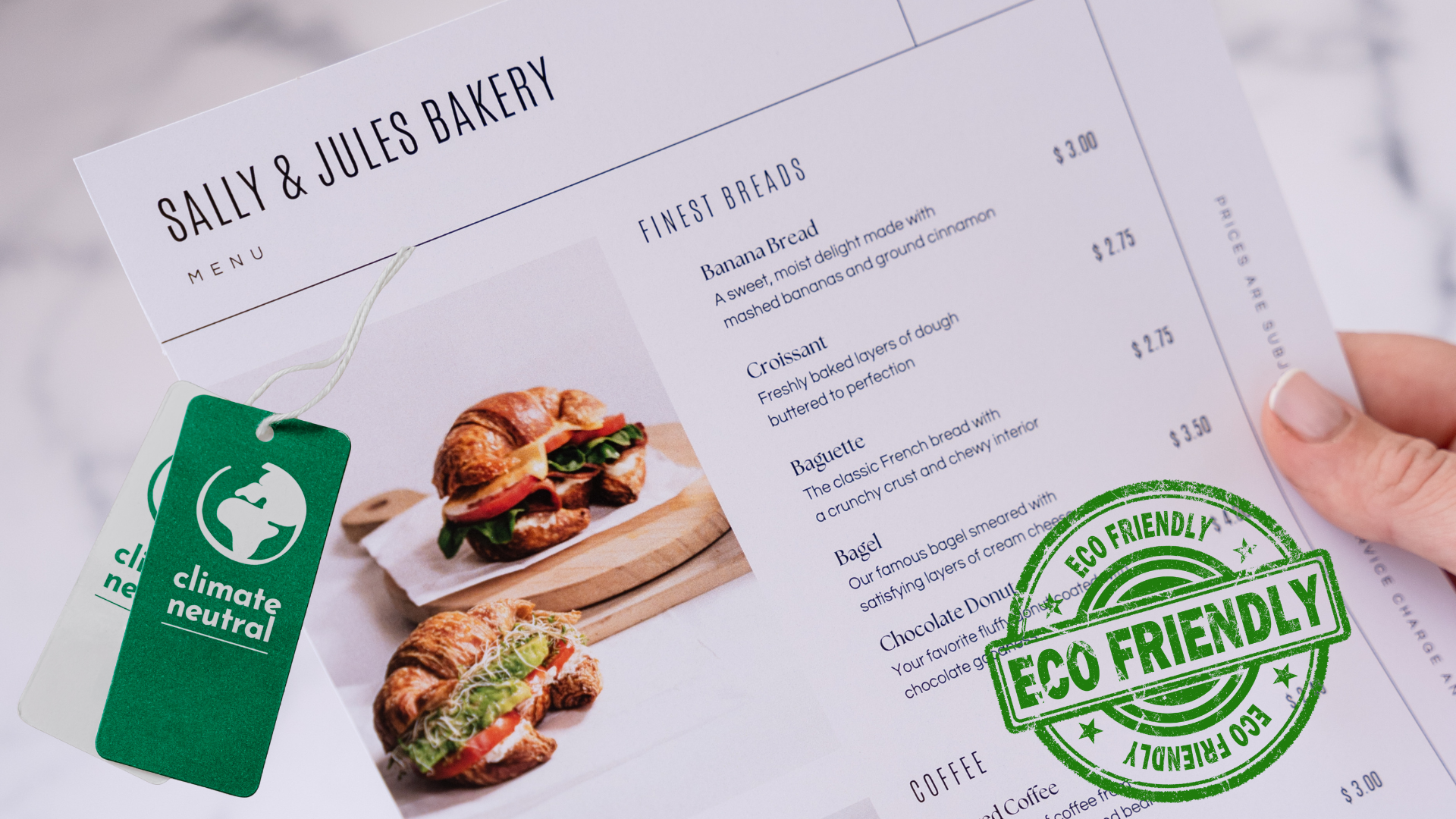
    • Generic claims: A generic environmental claim such as “eco-friendly”, “green”, “ecological” or “environmentally correct” is banned unless the business can demonstrate recognised excellent environmental performance relevant to the claim, for example through the EU Ecolabel or an officially recognised EN ISO 14024 type I ecolabel. A claim is not “generic” if its specification is given in clear and prominent terms on the same medium.
    • Offset-based product claims: It is banned to claim, based on offsetting greenhouse gas emissions, that a product has a neutral, reduced or positive impact on the environment in terms of greenhouse gas emissions.
    • Sustainability labels: Displaying a sustainability label that is not based on a certification scheme or established by public authorities is banned. This can include in-house badges, logos and ratings.
    • Whole-product claims: Making an environmental claim about a whole product or business when it only concerns one aspect is banned.
    • Legal requirements as a selling point: Presenting something the law requires of all products in that category on the EU market as a distinctive feature of your offer is banned.
    • Future performance claims: Claims such as “net zero by 2030” are misleading unless backed by clear, publicly available, verifiable commitments in a detailed, realistic implementation plan with measurable, time-bound targets, regularly verified by an independent third-party expert whose findings are available to consumers.
    • Irrelevant benefits and comparisons: Advertising benefits that are irrelevant and do not result from any feature of the product or business can be misleading. Comparisons on environmental characteristics must explain the method, the products and suppliers compared, and how the information is kept up to date.

    EU: WHAT COUNTS AS A CERTIFICATION SCHEME? EU

    Under EmpCo, you can only display a sustainability label (a trust mark, quality mark or similar that promotes a product or business on environmental or social grounds) if it is established by public authorities or based on a certification scheme. A certification scheme is a third-party verification scheme whose terms, including its requirements, are publicly available and which meets all of these conditions:

    • It is open to all traders willing and able to meet its requirements, on transparent, fair and non-discriminatory terms.
    • Its requirements are developed by the scheme owner in consultation with relevant experts and stakeholders.
    • It has procedures for dealing with non-compliance, including withdrawing or suspending the label.
    • Compliance is monitored through an objective procedure by a third party whose competence and independence from both the scheme owner and the trader are based on international, EU or national standards and procedures.

    What this means for own labels: self-certification is not enough. A badge you design and award to your own dishes, or a rating applied by you or your software provider without independent monitoring, is unlikely to qualify. In principle a business can own a scheme, but it must still meet every condition above, including being open to other businesses and monitored by an independent third party.

    Food note: The Directive confirms labels can still be shown without a certification scheme where they are additional forms of expression and presentation of food under Article 35 of the Food Information to Consumers Regulation (EU) No 1169/2011. Article 35 covers additional presentation of the nutrition declaration, so it does not cover carbon or environmental ratings.

    WHAT THIS MEANS FOR FOOD SERVICE BUYERS

    Repeating an unverified supplier claim, or relying on offset credits to make a product claim, now carries real financial risk. In the UK, the CMA can fine directly. In the EU, national authorities enforce EmpCo and set penalties under national law. The safest approach is to hold robust, up-to-date evidence for every claim before you make it, and to keep that evidence organised so it can be shown to a regulator.

    THREE PILLARS OF GREEN CLAIMS COMPLIANCE IN FOOD SERVICE

    Compliant environmental claims in catering and food service rest on three foundations:

    Compliance manager reviewing evidence for food service green claimsPILLAR 1

    SUBSTANTIATE EVERY CLAIM

    Under the Green Claims Code, claims must be backed by robust, credible evidence and should consider the full life cycle of the product. Highlighting sustainable sourcing while ignoring significant impacts elsewhere, such as packaging, may mislead.

    Food packaging green claims review removing generic eco claims and offset-based claimsPILLAR 2

    REVIEW GENERIC & OFFSET-BASED CLAIMS

    In the EU, EmpCo bans unsupported generic claims such as “green” and offset-based claims that a dish or product is carbon neutral. In the UK these are not banned outright, but vague or offset-based claims carry a high risk of misleading consumers.

    Food service procurement team checking certifications and recipe carbon dataPILLAR 3

    RECOGNISED LABELS & VERIFIABLE PLANS

    In the EU, sustainability labels must be based on a certification scheme or set up by public authorities, and claims about future performance need an independently verified implementation plan. In the UK, avoid self-made logos that suggest independent approval.

    ACTION PLAN FOR GREEN CLAIMS IN FOOD SERVICE

    Use these six steps to bring environmental claims across your menus, packaging and marketing under control. Steps marked EU reflect specific EmpCo bans; steps marked UK apply to UK claims.

    1. AUDIT ALL PACKAGING & MENU CLAIMS UK EU

    List every environmental claim on takeaway containers, cup sleeves, napkins, printed and digital menus, delivery app listings and marketing. Include claims passed on from suppliers. Flag any claim you cannot currently support with evidence.

    2. REVIEW OFFSET-BASED CLAIMS EU UK

    For EU consumers, remove claims such as “Carbon Neutral Lunch” or “Climate Compensated Meal” where they rely on offsetting, because EmpCo bans offset-based claims of neutral, reduced or positive product impact. For UK consumers, these claims are not banned outright, but any reliance on offsetting must be clear and the claim must not mislead.

    3. BUILD AN EVIDENCE FILE FOR EVERY CLAIM UK EU

    Recipe-level carbon data can support dish claims, provided the method and data sources are sound and documented. Recipe management software makes this easier to maintain across large menus, but the legal test is the quality of the evidence, not the tool used to produce it.

    4. REPLACE GENERIC CLAIMS & SELF-MADE LOGOS EU UK

    Swap vague terms like “100% Eco-Friendly” for specific, evidenced statements. In the EU, a self-designed badge such as a “Green Choice” leaf is banned unless it is based on a certification scheme or established by public authorities (see what counts as a certification scheme). In the UK, make sure any logo does not imply independent approval it does not have.

    5. USE RECOGNISED STANDARDS & PUBLISHED PLANS UK EU

    Where packaging claims rely on a standard, name it (for example FSC, PEFC or EN 13432 industrial compostability). If you promote future targets such as net zero, publish a detailed plan with measurable, time-bound targets. For EU consumers, that plan must also be regularly verified by an independent third-party expert.

    6. SHOW DISH FOOTPRINTS TRANSPARENTLY UK EU

    If you show dish carbon figures (for example grams of CO2e), make the method and data sources easy to find, such as through a QR code on the menu. Take care with graded ratings or badges, such as A–E carbon scores: in the EU, a rating shown as a label may count as a sustainability label, so it must be based on a certification scheme, with independent monitoring, or established by public authorities.

    INTERACTIVE CHECK

    CHECK ONE GREEN CLAIM AGAINST THE KEY RULES

    Answer nine questions about a single menu, packaging or marketing claim. The check covers the Green Claims Code principles and the EmpCo rules on environmental claims and labels. Repeat it for each claim you make. It does not cover EmpCo’s separate rules on product durability and repair.

    GOOD PRACTICE FOR ENVIRONMENTAL CLAIMS

    These safeguards go beyond the minimum and make claims easier to defend if a regulator asks:

    • CONSISTENT RECIPE-LEVEL DATA:
      Base dish footprints on a consistent, documented method and credible environmental data sources, and update them when recipes or suppliers change.
    • CENTRAL EVIDENCE REGISTER:
      Keep test reports, supplier declarations, certificates and calculation records for every packaging line and menu item in one place.
    • CHECK SUPPLIER CLAIMS BEFORE REPEATING THEM:
      Ask for the evidence behind any environmental claim a supplier gives you before using it on your own menus or packaging.
    • CLEAR DISPOSAL INSTRUCTIONS:
      Avoid unqualified terms like “biodegradable” or “compostable”. State exactly how to dispose of the item, e.g. “Compostable in industrial facilities only. Do not home compost.”

    ENFORCEMENT AT A GLANCE

    WHO ENFORCES GREEN CLAIMS RULES

    UK: Under the Digital Markets, Competition and Consumers Act 2024, the CMA can impose fines of up to £300,000 or 10% of global turnover, whichever is higher, without going to court. Trading Standards also enforce consumer law. The ASA rules on advertising, including online and social media marketing, and can have ads withdrawn, but it cannot fine.

    EU: National consumer protection authorities enforce EmpCo through each member state’s own law, and penalties are set nationally. In Ireland, see the Department of Enterprise guidance.

    Keep supplier specifications, dish footprint calculations and certificates together in a green claims evidence folder, ready to share if a regulator asks.

    REVIEW YOUR GREEN CLAIMS NOW

    EmpCo now applies across the EU and the CMA can fine directly in the UK. Audit your menu copy, carbon claims and packaging, and remove or rework any claim you can’t support.