
HOW TO CALCULATE QUID
A STEP-BY-STEP GUIDE
Once you know a product needs a QUID, this guide shows you how to calculate QUID step by step, using food service examples such as central kitchen batches, grab-and-go products and dishes that lose water when cooked. It also includes a calculator.
HOW TO CALCULATE QUID IN 30 SECONDS
-
1
Weigh each ingredient as it goes in
Record the weight of each ingredient at the point you add it to the recipe. This is the “mixing bowl stage”.
-
2
No water lost? Use the total weight
Divide the ingredient’s weight by the total weight of all ingredients, then multiply by 100.
-
3
Water lost in cooking? Use the finished weight
Divide the ingredient’s weight by the weight of the finished product instead, then multiply by 100.
-
4
Over 100%? Change the format
If a result, or all your declared QUIDs added together, go over 100%, write “Made with X g of [ingredient] per 100 g”.
Keep records of your weights, yields and calculations, and recalculate whenever a recipe, supplier or cooking method changes.
KEY TERMS
Mixing bowl stage
The point at which each ingredient goes into the recipe. QUID uses ingredient weights at this stage.
Finished weight
The weight of the product after cooking or other treatment, as it will be sold.
Yield
How much the weight changes during preparation. A dish that goes in at 10 kg and comes out at 8.5 kg has an 85% yield.
Compound ingredient
An ingredient made from other ingredients, such as a sauce, pastry or bread, used in another recipe.
FIRST, CHECK YOU NEED A QUID
QUID applies to prepacked food, including food your central kitchen packs and sends to other sites. You need one when an ingredient is in the name of the food, expected from the name, highlighted on the pack, or essential to what the food is (Article 22). For the full rules and a checker, see When Is a QUID Required?
WHAT THIS MEANS FOR FOOD SERVICE
- Prepacked food, including food packed at one site and sold at another: QUID applies.
- UK loose and PPDS food: no general QUID requirement. The only requirement is a meat content declaration for foods containing meat, and it doesn’t apply to ready-to-eat food from restaurants, cafés, canteens and other mass caterers, or to sandwiches, filled rolls and pizzas.
- EU loose food: EU law doesn’t require a QUID, but individual countries can add national rules, so check where you trade.
- Supplying caterers: prepacked food supplied to caterers still needs any required QUID, although suppliers can give some information on delivery notes or specification sheets instead of the pack (Article 8(7)).
HOW TO CALCULATE QUID
THE BASIC CALCULATION
Weigh each ingredient as it goes into the recipe, then divide the ingredient you’re declaring by the total of all ingredients (Annex VIII, point 3).
Use this when the product doesn’t lose water after mixing, such as salads, sandwich fillings and cold desserts.
| Example: chicken Caesar salad pots, made as one central kitchen batch | Weight |
|---|---|
| Cooked chicken | 2.5 kg |
| Lettuce | 5 kg |
| Dressing | 1.5 kg |
| Croutons and cheese | 1 kg |
| Total | 10 kg |
Chicken QUID = 2.5 ÷ 10 × 100 = 25%. You weigh the chicken as it goes in. Here that’s its cooked weight, because you add chicken that’s already cooked.
Show the QUID either in or next to the name of the food, or in the ingredients list next to the ingredient, for example “Chicken (25%)”.
WHEN THE CALCULATION CHANGES
Cooking and processing can change the weights, so the law sets out some special cases (Annex VIII, point 4). These are the ones food service teams meet most often. Select a card to see the rule and an example.
1. IF THE DISH LOSES WATER WHEN COOKED

Many dishes lose water in the oven or during other treatment, such as pies, lasagnes, bakes and roasted products. For these, divide the weight of the ingredient you used by the weight of the finished product (Annex VIII, point 4(a)).
Example: a central kitchen beef lasagne batch uses 3 kg of beef mince in 10 kg of ingredients, and weighs 8.5 kg after baking. Beef QUID = 3 ÷ 8.5 × 100 = 35%.
2. IF THE ANSWER COMES OUT OVER 100%

When a product loses a lot of water, the calculation can give more than 100%. If this happens for any ingredient, or if all your declared QUIDs add up to more than 100%, show the weight of the ingredient used to make 100 g of the finished product instead (Annex VIII, point 4(a)).
Example: your central kitchen roasts 1.2 kg of seasoned beef, which comes out at 900 g for packed sandwich-filler slices. 1.2 ÷ 0.9 × 100 = 133%, so the label reads “Made with 133 g of beef per 100 g of product”.
Only switch to this format once a result goes over 100%. Below that, use a normal percentage.
3. IF WATER OR ALCOHOL COOKS OFF

Some ingredients partly evaporate during cooking, such as water, stock or wine. For these, base the quantity on how much is left in the finished product, not how much you added (Annex VIII, point 4(b)).
Example: if a beef bourguignon label says “made with red wine”, the wine QUID reflects the wine remaining in the finished dish, not the amount poured into the pan.
4. CONCENTRATED AND DRIED INGREDIENTS
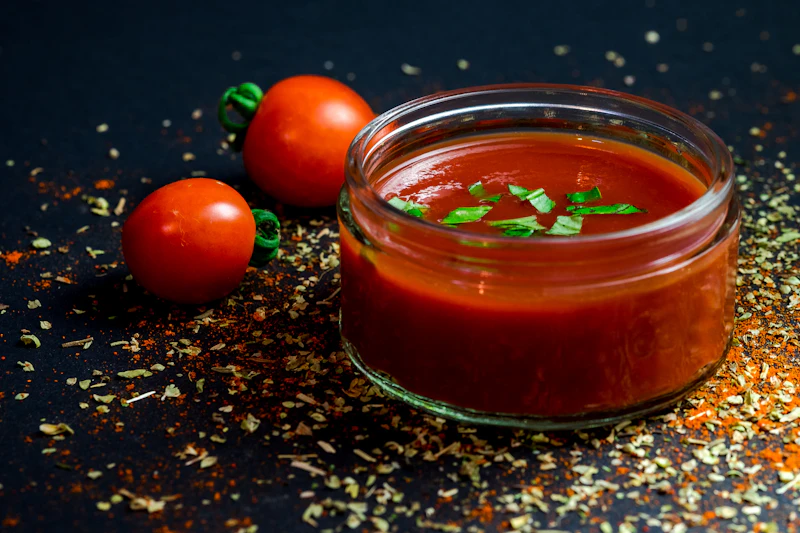
Ingredients rehydrated or diluted during preparation, such as tomato purée or milk powder: you may base the QUID on their weight before they were concentrated or dried (Annex VIII, point 4(c)). For example, a bolognese highlighting “tomatoes” could declare the equivalent weight of fresh tomatoes.
Products the customer makes up, such as soup or gravy mixes: you may base the QUID on the made-up product (Annex VIII, point 4(d)).
5. INGREDIENTS YOU COOK FIRST

Kitchens often cook an ingredient before it goes into the final recipe, such as rice for salad pots or pulses for a chilli. These absorb water, so the cooked weight is much higher than the dry weight.
The law doesn’t give a specific rule for this. Because QUID reflects the ingredient at the time of use, decide which weight you use, document it, and apply it consistently at every site. Make sure the result doesn’t mislead customers about how much of the ingredient they’re getting. If you’re unsure, check the Commission’s QUID guidelines or ask your enforcement authority.
6. WHEN YOU DON’T NEED A QUID

You don’t need a QUID for an ingredient if (Annex VIII, point 1 of Regulation (EU) No 1169/2011):
- it’s only used in a small amount for flavour, such as herbs, spices or a splash of wine;
- it’s named in the food, but the amount doesn’t affect what customers choose, because changing the amount wouldn’t change the character of the food;
- the drained weight is already shown on the label, as with tinned fruit;
- other rules already require the amount to be shown on the label;
- other legislation already fixes exactly how much must be used, without requiring it on the label; or
- it’s part of a mix of fruit, vegetables, mushrooms, herbs or spices where none clearly dominates and the label says the mix is in varying proportions.
Ingredients under 2% are not automatically exempt. The 2% rule only lets you list those ingredients in a different order, after the other ingredients.
QUID CALCULATOR
Enter weights in grams. Leave the finished weight blank if the food doesn’t lose moisture after mixing.
This calculator applies the basic rule and the moisture-loss rule in Annex VIII. It doesn’t handle volatile or reconstituted ingredients. Because it checks one ingredient at a time, add up all the QUIDs you plan to declare: if they exceed 100%, use the “per 100 g” format for all of them.
FOR MULTI-SITE OPERATORS: HOW TO CALCULATE QUID CONSISTENTLY
The law sets out how to express a QUID. However, it doesn’t tell you how to get the weights, and this is where multi-site operations most often go wrong. Good practice is to:
- Weigh real batches where the food is made. Record each ingredient as it goes in and the finished weight, across several batches, to get a reliable yield.
- Expect yields to vary between sites. Different ovens, batch sizes and cooking times change how much water the food loses. If several sites make the same product, standardise the method, or base the label on data from each production site.
- Use published yield factors only as a starting point. EuroFIR and FAO publish weight yield factors, developed mainly for nutrition calculations. Your own measured yields are more accurate.
- Control local substitutions. A site swapping an ingredient or supplier can change the QUID and the allergen information.
- Recalculate when anything changes, including a recipe, supplier, batch size or cooking method.
- Keep records of the weights, yields and calculations behind each declaration, so you can show how you reached it.
A recipe management system can automate QUIDs across all your sites, applying these rules to your master recipes and recalculating when recipes or supplier specifications change. Choose one that follows recognised recipe calculation methods, such as the EuroFIR recipe calculation procedure and FAO/INFOODS guidance, and lets you use your own measured cooking yields. The result still depends on the recipe weights you enter.
NOT SURE IF YOU NEED A QUID?
Our companion guide explains the triggers, how the rules change by selling format, and includes an interactive checker.
QUESTIONS ABOUT QUID?
We can answer questions on QUID and labelling, and help with recipe and labelling systems.
OFFICIAL SOURCES
- Regulation (EU) No 1169/2011 (EUR-Lex)
- Annex VIII as it applies in Great Britain
- Commission Notice on the application of the QUID principle (2017/C 393/05)
- GOV.UK: Packaging and labelling
This page is for general information only and is not legal advice.